

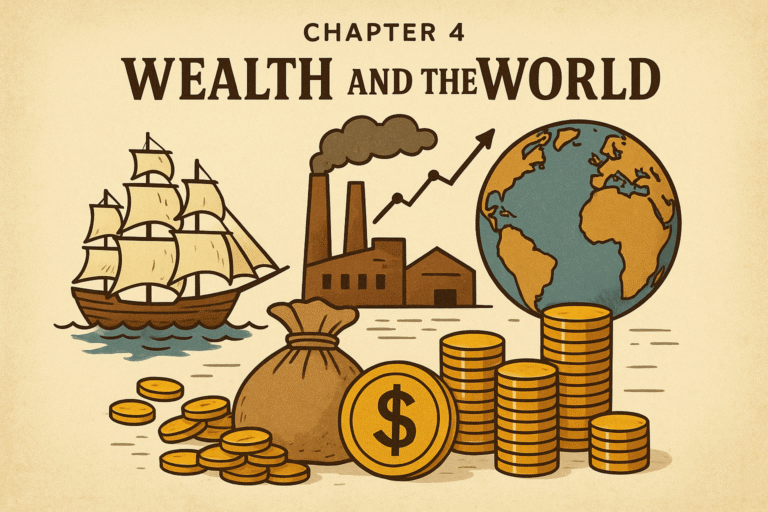
The chapter “Wealth and the World” explains how economic changes transformed the world from the medieval period to the modern age. It focuses on the growth of trade, industries, capitalism, and global connections that reshaped societies and economies. The chapter describes how wealth was generated through agriculture, trade, colonisation, and later through industrial production. It also explains the shift from a feudal economy to a market-based economy and the rise of new social classes such as merchants and industrialists. European countries expanded overseas trade and established colonies, which helped them accumulate enormous wealth but often led to the exploitation of colonies. The chapter highlights how economic changes affected ordinary people, including workers and peasants, and widened social inequalities. Overall, the lesson helps students understand how wealth creation, economic power, and global trade influenced political control, social structure, and the modern world system.
Content
- Meaning and sources of wealth
- Growth of trade and commerce
- Rise of capitalism
- Role of colonialism in wealth accumulation
- Industrial growth and economic changes
- Impact of economic changes on society
- Inequality and exploitation in the world economy
- Wealth: Wealth refers to the resources, money, land, and goods owned by individuals or nations.
- Economic Activities: Activities related to production, distribution, and consumption of goods and services.
- Agriculture as a Source of Wealth: In early societies, agriculture was the main source of wealth and livelihood.
- Surplus Production: Extra production beyond basic needs enabled trade and wealth accumulation.
- Barter System: Early method of exchange where goods were traded for goods without money.
- Development of Trade: Trade expanded when surplus goods were exchanged across regions.
- Local Trade: Trade carried out within villages and nearby regions.
- Long-distance Trade: Trade between distant regions helped connect different parts of the world.
- Merchant Class: A new class that emerged through trade and accumulated wealth.
- Urban Centres: Cities grew as centres of trade, markets, and economic activities.
- Market Economy: An economy where prices and production are determined by demand and supply.
- Money Economy: Replacement of barter with coins and currency simplified trade.
- Capital: Wealth used to produce more wealth, such as money invested in business.
- Capitalism: An economic system based on private ownership and profit-making.
- Banking System: Banks helped in saving, lending, and investing money.
- Credit System: Traders and entrepreneurs borrowed money to expand businesses.
- Colonial Expansion: European powers established colonies to control resources and trade.
- Colonies: Territories controlled by powerful nations for economic benefit.
- Exploitation of Colonies: Colonies supplied raw materials and cheap labour to colonising countries.
- Raw Materials: Natural resources used for manufacturing goods.
- Industrial Revolution: Shift from manual production to machine-based production.
- Factories: Large-scale production units that increased output and profits.
- Industrial Capitalists: Owners of factories who controlled production and wealth.
- Working Class: Labourers who worked in factories for wages.
- Wage Labour: System where workers sell their labour for wages.
- Urbanisation: Growth of cities due to industrial and economic development.
- Global Trade Network: Worldwide system connecting producers and consumers.
- Trade Routes: Sea and land routes that enabled international trade.
- Commercial Crops: Crops grown for sale, not for personal consumption.
- Plantation Economy: Large farms producing crops like tea, coffee, and sugar.
- Slave Labour: Forced labour used especially in plantations and colonies.
- Profit Motive: Desire to earn maximum profit drives economic activities.
- Economic Inequality: Unequal distribution of wealth among people and nations.
- Rich and Poor Nations: Industrialised countries became rich, while colonies remained poor.
- Monopoly: Control of trade or production by a single group or country.
- Mercantilism: Economic policy focusing on increasing national wealth through trade surplus.
- Export: Goods sold to other countries.
- Import: Goods bought from other countries.
- Trade Imbalance: Situation where imports exceed exports or vice versa.
- Infrastructure Development: Roads, ports, and railways developed mainly for trade.
- Technological Advancement: New inventions increased production and efficiency.
- Transportation Revolution: Steamships and railways improved trade speed.
- Communication Systems: Telegraph and postal systems helped trade coordination.
- Consumer Markets: Colonies served as markets for finished goods.
- Wealth Concentration: Wealth accumulated in the hands of a few individuals or nations.
- Economic Power: Control over wealth gave political and global influence.
- Modern World Economy: Result of centuries of trade, capitalism, and industrialisation.
- Interdependence of Nations: Countries depend on each other for goods and resources.
- Social Impact of Wealth: Economic changes altered social structures and lifestyles.
- Significance of the Chapter: Helps understand how economic forces shaped the modern world.
Short Questions and Answers
- What is meant by wealth?
Wealth refers to the resources, money, land, and goods owned by individuals or nations. - Name one early source of wealth.
Agriculture was one of the earliest and most important sources of wealth. - What is surplus production?
Surplus production is the production of goods beyond basic needs. - What was the barter system?
It was a system of exchange where goods were exchanged directly without money. - How did trade help in wealth creation?
Trade enabled the exchange of surplus goods, leading to profit and wealth accumulation. - Who were merchants?
Merchants were traders who bought and sold goods and accumulated wealth. - What is meant by a market economy?
An economy where production and prices depend on demand and supply. - What is capital?
Capital is wealth used to produce more wealth. - Define capitalism.
Capitalism is an economic system based on private ownership and profit. - What role did banks play in trade?
Banks provided credit, loans, and safe storage of money. - What is colonialism?
Colonialism is the control of one country over another for economic benefits. - Why were colonies important to European nations?
Colonies provided raw materials, labour, and markets. - What is meant by raw materials?
Raw materials are natural resources used to manufacture goods. - What was the Industrial Revolution?
It was the shift from manual production to machine-based production. - What is a factory system?
A system of large-scale production using machines and labour. - Who were industrial capitalists?
Owners of factories and industries who controlled production. - Who formed the working class?
Factory workers who worked for wages. - What is wage labour?
A system where workers are paid wages for their work. - What is economic inequality?
Unequal distribution of wealth among people or nations. - Why is this chapter important?
It explains how economic changes shaped the modern world.
Medium Questions and Answers
- Explain the meaning of wealth and its importance in human society.
Wealth includes money, land, goods, and resources owned by individuals or nations. It determines living standards, economic power, and social status. - How did agriculture contribute to the growth of wealth?
Agriculture produced food surpluses, supported population growth, enabled trade, and became the base of early economies. - Describe the transition from barter system to money economy.
The barter system had limitations. The introduction of money simplified exchange, expanded trade, and promoted economic growth. - Explain the role of trade in wealth creation.
Trade enabled exchange of surplus goods, promoted specialisation, and helped merchants accumulate wealth. - How did the merchant class emerge?
Expansion of trade led to the rise of merchants who controlled commerce and accumulated capital. - What is meant by capitalism? Explain its features.
Capitalism is based on private ownership, profit motive, wage labour, and market competition. - Explain the role of banks in economic development.
Banks provided credit, encouraged investment, supported trade, and ensured safe money transactions. - How did colonialism help European countries accumulate wealth?
Colonies supplied raw materials, labour, and markets, increasing profits for European nations. - Explain the exploitation of colonies.
Colonies were forced to supply cheap raw materials and labour, while profits flowed to colonisers. - Describe the Industrial Revolution and its economic impact.
Industrial Revolution introduced machines, factories, mass production, and increased wealth. - How did industrialisation change production methods?
Production shifted from small-scale manual work to large-scale machine-based factory systems. - Explain the growth of the working class.
Factories required labour, leading to migration to cities and growth of wage workers. - What were the effects of industrialisation on cities?
Cities expanded rapidly, leading to urbanisation and new economic opportunities. - Explain global trade networks.
Countries became connected through trade routes exchanging raw materials and finished goods. - What is meant by commercial agriculture?
Farming done mainly for sale and profit rather than self-consumption. - Describe plantation economy.
Large estates produced crops like tea and sugar using cheap labour for export. - How did transportation improvements support trade?
Railways and steamships reduced time and cost of transport, boosting trade. - Explain economic inequality created by wealth accumulation.
Wealth concentrated among a few nations and individuals, widening the rich-poor gap. - How did economic power influence political power?
Wealth enabled nations to control territories, resources, and global politics. - Why is the study of wealth important in history?
It explains economic forces behind social change and global dominance.
Long Questions and Answers
- Explain how the concept of wealth changed from the medieval period to the modern age.
In the medieval period, wealth was mainly land-based and controlled by feudal lords. Agriculture determined economic power. With the growth of trade and markets, wealth shifted to money and movable assets. Merchants accumulated capital through commerce. Later, industrialisation transformed wealth into factory ownership, machines, and capital investment. Thus, wealth moved from land to trade and finally to industrial capital. - Analyse the role of agriculture in early wealth formation.
Agriculture provided food security and surplus production. Surplus enabled trade, population growth, and urban centres. Agricultural taxes and land ownership became sources of state revenue. It formed the foundation for economic systems before industrialisation. - Describe the evolution of trade and its impact on the world economy.
Trade evolved from local barter to long-distance and international trade. Sea routes connected continents. Trade promoted specialisation, expanded markets, and generated profits. It laid the foundation for capitalism and global economic integration. - Discuss the emergence and importance of the merchant class.
Merchants emerged with expanding trade. They controlled markets, accumulated capital, and influenced policies. Their wealth weakened feudalism and supported the rise of capitalism and urbanisation. - Explain capitalism and its major characteristics.
Capitalism is based on private ownership, profit motive, wage labour, competition, and market control. Capitalists invest money to generate profit. It encouraged innovation and economic growth but also caused inequality. - Evaluate the role of banking and credit systems in wealth creation.
Banks mobilised savings, provided loans, facilitated trade, and reduced risk. Credit enabled business expansion and industrial investment, accelerating economic growth. - Analyse how colonialism contributed to European wealth.
Colonies supplied cheap raw materials, labour, and served as markets. Profits flowed to Europe, strengthening industries and finance. Colonial exploitation created global inequality. - Explain the exploitation of colonies with suitable examples.
Colonies were forced to grow commercial crops and supply minerals. Local industries declined. Labour was underpaid or forced. Economic benefits largely favoured colonisers. - Describe the Industrial Revolution and its causes.
Technological inventions, capital availability, raw materials, and markets led to industrialisation. It transformed production methods and increased wealth generation. - Discuss the economic impact of industrialisation.
Industrialisation increased production, profits, employment, and trade. It strengthened capitalist economies but also created worker exploitation and inequality. - Explain the growth of factories and factory systems.
Factories centralised production, used machines, divided labour, and increased efficiency. They became centres of wealth accumulation. - Analyse the formation and conditions of the working class.
Workers migrated to cities for factory jobs. They faced long hours, low wages, and poor living conditions, leading to social tensions. - Describe the process and effects of urbanisation.
Industrial growth expanded cities. Urbanisation created jobs and markets but caused overcrowding, pollution, and social problems. - Explain global trade networks and their significance.
Global trade connected continents through sea routes. It enabled resource flow, economic interdependence, and the formation of a world economy. - Discuss commercial agriculture and plantation economy.
Commercial agriculture focused on profit crops. Plantations used large landholdings and cheap labour, mainly for export, benefiting colonisers. - Analyse the role of transportation and communication in economic expansion.
Railways, steamships, and telegraphs reduced costs and time, expanded markets, and strengthened global trade. - Explain how wealth concentration led to economic inequality.
Wealth accumulated among industrialists and colonial powers, while workers and colonies remained poor, widening disparities. - Evaluate the relationship between economic power and political power.
Wealth enabled military strength, colonial control, and political dominance, shaping global politics. - Discuss the social impact of wealth creation.
Wealth changed class structures, lifestyles, and labour relations. It created new elites and social conflicts. - Why is the study of wealth important for understanding the modern world?
It explains global inequality, economic systems, colonial legacies, and the forces shaping contemporary societies.

